


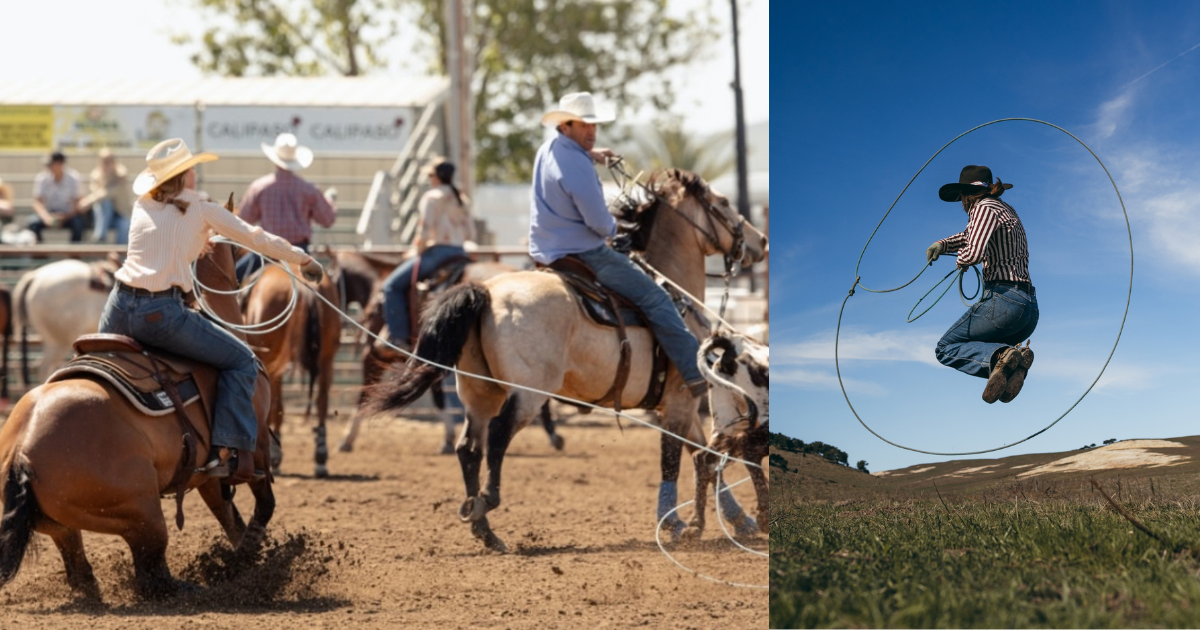
When Chelsey Bushnell was a little girl in California, she had a pretty simple idea of what success with a rope looked like: she wanted to make a living with it.
At the time, the road she imagined ran through the arena. Bushnell wanted to breakaway rope, team rope and maybe even be the first woman to make the NFR in the team roping.
“I’ve always, since I’ve been little, wanted to make a living with my rope,” she said.
She couldn’t have known then how literal that childhood goal would eventually become.
Bushnell isn’t rodeoing full time today, but the rope that carried her through junior rodeos, California state championships and college rodeo has followed her into almost every part of adulthood. She works in marketing for some of the heavy hitters of the Western industry, coaches college rodeo athletes, still team ropes and makes horses, and has turned the trick roping she once did for fun into a recognizable platform and business.
There is even a Cactus rope bearing her name.
It isn’t exactly the life she pictured when she was a kid, but it is undeniably a life built around a rope.
Growing Up With It
Sports and rodeo ran side by side through Bushnell’s childhood in Northern California. She competed through junior, junior high and high school rodeo while also playing basketball and travel ball.
When Bushnell was 6, her parents moved to the property where they still live and built a small arena. Keeping cattle at home wasn’t always practical with the family’s busy schedule, but not having live cattle didn’t mean Bushnell wasn’t roping.
“We pulled the sled every day,” the now-30-year-old said. “We mainly roped the sled here and went and practiced at weekly night practices in town at different arenas. But yeah, I just spent most of my life roping the dummy.”
She started on ponies before graduating to older, proven horses that had already carried friends of her parents through their own rodeo careers.
One was Sugar Bear, an older college-level breakaway horse Bushnell got around sixth grade. Their first runs together required some adjustment—Bushnell remembers roping a calf and Sugar Bear stopping so hard that she flipped over the front of him and landing on her back—but she eventually figured him out.
By her sophomore year of high school, Bushnell and Sugar Bear were reserve California state champions in the breakaway. After Sugar Bear died, another mare came along at the right time. Bushnell won her district and then the California State Finals on the mare and repeated the state title again her senior year.
Her success followed her into college, although not without an interruption. Bushnell tore her ACL playing basketball her senior year of high school and had surgery shortly before leaving for college. She sat out the fall rodeo season, returned in the spring and eventually finished fourth in the breakaway at the College National Finals Rodeo.
She also competed at WPRA events and some of the early professional rodeos offering breakaway roping, including a win at the Santa Maria Elks Rodeo.
Her older brother headed, so Bushnell started out primarily on the heel side. As a little girl, her dreams were as big as the opportunities available to her would allow.
“When I was little, I wanted to obviously make it to the NFR and be the first girl header/heeler at the NFR,” Bushnell said.
She breakaway roped, team roped and even envisioned barrels as part of the equation. But the landscape for women with a rope looked considerably different than it does now. Breakaway had long existed in youth, high school, college and WPRA competition, but the professional opportunities available to women today had yet to develop.
Still, a rope was already helping Bushnell build a life.
“Back then there wasn’t really as many opportunities as there is now as far as everything in women’s roping,” Bushnell said. “But I was able to, growing up all through high school and college, I was able to make a living, make it through school with my rope.”
She had already accomplished part of the childhood goal—she just didn’t yet know how many different forms it could take.
When It Became a Career
Trick roping had been around nearly as long as Bushnell’s in-arena roping, but for years she thought of it as little more than something fun to do.
With a brother five years older, Bushnell spent plenty of time at high school rodeos before she was old enough to compete herself. His friends would trick rope around the rodeo grounds, and Bushnell watched.
“I was always bored and not entered at those high school rodeos,” she said. “I just always would watch those guys and try to pick up tricks and stuff.”
Her ACL injury inadvertently pushed the skill further.
Bushnell had surgery after her senior year and left for college 15 days later on crutches. Unable to ride for roughly six months, she worked the chutes and spent hours roping the dummy with the other college rodeo kids.
Bushnell earned an undergraduate degree in kinesiology at Chico State after initially considering physical therapy. Later, an opportunity to spend a fifth year rodeoing at Cal Poly led her there for a master’s degree in agricultural education and an assistant coaching role.
After graduating in 2019, she thought coaching might become her career. Instead, Dustin Noblitt offered her a marketing position with Heel-O-Matic.
“I was like, ‘I don’t know. I don’t know what to do with marketing. I don’t know anything,’” she said of the opportunity at first.
She took the job anyway. Soon afterward, COVID-19 shut down schools, making the unexpected decision particularly timely. Marketing placed Bushnell even deeper in the Western industry, and at the same time, people were beginning to recognize another part of her skill set.
Everybody knew her as the trick roper. Initially, she didn’t love it.
“I was always so against that when I was younger because I love to heel,” Bushnell said. “I want to be one of the girls that heels really good, not as a trick roper.”
Eventually, she decided to own it.
Bushnell created a dedicated social media page, though marketing herself felt uncomfortable. Lari Dee Guy encouraged her to quit treating it as something she needed to hide.
“She was like, ‘Hey, you need to do something with that,’” Bushnell recalled. “‘I know it’s weird and it’s not comfortable, but you need to market yourself. You got something right there that you can do something cool with.’”
Bushnell began posting more consistently. Her audience grew, brand collaborations followed and the side project slowly became Chelsey Trick Ropes on social media.
In 2026, Cactus introduced the CTR, the Chelsey Trick Rope.
“It’s kind of just turned into a little business,” Bushnell said.
At the same time, her career in the industry continued expanding. Today her marketing work includes social media for Cactus Ropes/Saddlery/Gear and Cowboy’s Choice. She also spent the last two years assistant coaching part time at Cal Poly before recently moving home to Red Bluff, and she continues to help with the program.
Yet what matters most to Bushnell about the trick roping has little to do with performing—she wants to help people learn to handle their ropes better.
“My biggest thing is I love helping kids and people learn to rope and learn to handle their rope,” Bushnell said. “I think the better you can handle your rope, the better you can rope in general.”
That philosophy traces all the way back to the kid in Red Bluff who spent countless hours at the dummy because there weren’t always cattle ready to rope.
Now she gets to pass it along.
What It Means to be a Woman in Rodeo
Bushnell came of age during an interesting stretch for women in rodeo.
She grew up dreaming of becoming the first woman to reach places that girls today no longer have to imagine quite so abstractly. The professional opportunities in breakaway roping have grown enormously, while women continue finding places in team roping, training, coaching, marketing, media and nearly every other corner of the industry.
Bushnell’s own career has touched several of those worlds.
She has been the contestant, the coach and the person behind the marketing campaign. She has turned something as niche as trick roping into an audience and a business opportunity. Now, she has younger athletes watching her much the same way she once watched older ropers.
But when Bushnell thinks about what being a woman in rodeo means at this point in her life, she doesn’t frame it around proving herself against anybody else.
“For myself personally, at the point of life I am in right now, it’s having faith and good character and integrity and helping people in the industry that want to be involved in it as much as you can,” Bushnell said.
She credits much of her own path to people willing to share advice, whether that was someone showing her a new trick with a rope, helping with her competition or telling her to take a chance professionally.
Now, she wants younger people to stay receptive to the same thing.
“You can never stop learning,” Bushnell said.
After years spent moving quickly between college, rodeo, travel, marketing and coaching, Bushnell is also beginning to circle back toward some of the simplest pieces of the life that started it all.
She recently moved home to Red Bluff and wants to spend more time riding through horses and entering again. Team roping remains a priority, and she hasn’t ruled out returning to the breakaway if the right horse comes along.
“I’ve been living a pretty fast lifestyle since I graduated high school really,” Bushnell said. “I’ve been going really fast.”
Now, rather than locking herself into another plan, Bushnell is content to know the general direction she wants to go.
“I’m a very day-by-day person,” Bushnell said. “I have goals obviously, but I have almost a picture in my head of what I want to have for myself in the next five years. But I do take it step by step, one foot at a time.”
That makes sense considering the route that brought her here.
The little girl in Red Bluff thought making a living with her rope would mean winning inside an arena—she did plenty of that. What she couldn’t have known was how many other doors that same rope could open: college, coaching, a career, a business and an opportunity to help another generation become better ropers.
Bushnell got the life she dreamed about—it just came with a few more tricks than she planned.