


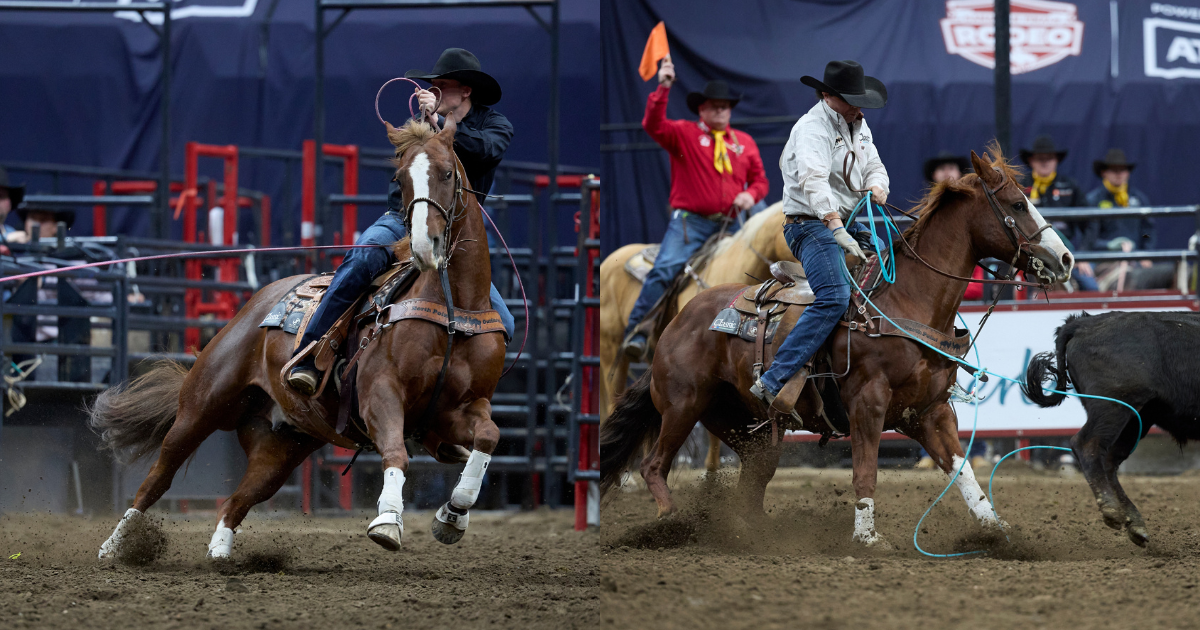
Kavis Drake and Denim Ross capped their year on the rodeo road with $47,034.10 a man and average and year-end titles at the 2026 Canadian Finals Rodeo in Edmonton, Alberta, while also finishing No. 23 in their respective PRCA world standings.
Drake, 20, of Moose Jaw, Saskatchewan, finished the PRCA regular season with $97,575, while Ross, 22, of Botha, Alberta, won $104,946.48 on the heel side.
Back north of the border, the team then won the CFR five-head average in 32.8 seconds, taking two round wins and placing in two others Oct. 7-10.
For Drake, it marked his second Canadian championship in three CFR appearances. For Ross, it was his first in five trips.
But their success went well beyond four days in Edmonton. After spending much of 2026 traveling throughout the United States and Canada, the young guns had put themselves within striking distance of their first National Finals Rodeo qualifications before falling outside the Top 15 in the final weeks of the regular season.
“If you’d have told me four years ago I’d have been in this spot, I would’ve called you crazy,” Drake said. “I’m just a kid from Saskatchewan in the middle of nowhere that just loved to rope. I never thought that at 20 years old I’d be top 25 in the world and a two-time Canadian champ.”
Tales From Edmonton
Drake and Ross entered the 2026 CFR with a different approach than in previous years.
These two know they can go fast, proven by the rodeos they won in the States like Bremerton, Washington, where they went 3.8 for $5,007 a man. But in Edmonton, the plan was to make good runs and catch every steer.
That plan paid off immediately with a 4.3-second Round 1 victory, followed by a 4.9-second run to finish third in Round 2.
Round 3 brought their only major setback of the Finals. After stopping the clock in 3.9 seconds, there was a barrier malfunction and they got the plus-10, turning what could have been a round win into a 13.9. Despite that, they still hung in there for fifth.
Rather than allow the setback to dictate the rest of their week, Drake and Ross returned in Round 4 with a 3.8-second run, the fastest of the CFR and good for another round win.
Heading into the fifth and final round, their championship hopes came down to catching their last steer. With Brett Buss and Joey Romo still in contention, Drake and Ross needed to complete the course to secure their titles.
The situation carried an added layer. Buss had been Ross’ first partner and had also helped Drake early in his career, selling him horses that contributed to his first Canadian championship.
“That’s who I started roping with,” Ross said. “He asked me to rope when I was a kid and we roped for a couple years.”
Drawing a stronger steer in the final round, Drake and Ross decided to be smart. Their 5.9-second run secured the average title and finished what they had set out to do.
“Our job going in there was catch five clean,” Drake said. “This year, our plan going in was just try not to beat ourselves and catch them all. And when it happened, I just went, ‘Perfect. We accomplished our goal.'”
For Drake, winning alongside Ross made the championship especially meaningful. He first won the Canadian title during his CFR debut, but this time he was able to share the accomplishment with someone he considers family.
“This one was special,” Drake said. “The first year I won it, it all happened really fast. It was the first year I made the CFR.”
“This year to get to win it with my partner, it was pretty special, especially Denim because he’s like a brother.”
For Ross, who celebrated his 22nd birthday the day they won the rodeo, the win rewarded a change in how they went about the Canadian Finals as a whole.
“That’s what made winning the average this year so rewarding—my goal was to catch five steers by two feet and if anyone else beat us, I could live with it,” Ross said.
Beneath the Border
The Canadian championship was the culmination of a season that took Drake and Ross farther into ProRodeo than ever before.
For the first time, the two made a serious run through the States, traveling between rodeos in the United States and Canada while chasing their first NFR qualifications.
“We went to quite a few in the States and it was a lot of fun,” Ross said. “Lots of the guys down there bugged us that we drove twice as much as everyone else, which we probably did.”
The work put both ropers in unfamiliar territory late in the regular season, sitting just outside the coveted Top 15 with a realistic chance at qualifying for Las Vegas.
“Obviously we wanted to make the NFR, but it was something that you’ve dreamed about so long,” Drake said. “It’s like, man, can we actually do it? Then this year, when we were barely on the outside looking in with a couple weeks left, we were 16, 17. It’s like, wow, we can actually do this.”
Although the final weeks didn’t go their way, the experience gave the young Canadians confidence that they could rope at that level.
“The last couple weeks didn’t go our way, which whatever, that’s rodeo,” Drake said. “It goes in waves. But honestly, it made me feel like I can do it.”
Their success has been built on a partnership that extends past the rodeo trail.
Four years ago, Drake traveled from Saskatchewan to stay with Ross’ family, originally planning to visit for a week. He never really left.
“I came for a week and haven’t left yet,” Drake laughed. “We spend every single day together. He’s not even really one of my best friends, but he’s more like a brother than a friend now.”
With Ross’ father, Rocky, producing team ropings and contracting cattle, Drake found himself surrounded by the sport every day. The two have spent the last three years entering together and putting in the work at home.
“I think moving in with Denim’s family was huge to me because this is what they do,” Drake said. “We rope a lot every single day. There’s horses around and me and Denim talk about the run a lot.”
“Without them, I would promise you I would not be where I am today.”
That routine has helped the boys develop the ability to hang with the best teams in the world. Drake said they go at nearly every practice run with the same intensity they have when their money is up, whether they’re trying to go 4-flat or simply make the most of a tough steer.
“We go full contact every single time,” Drake said. “We try to maximize every single time. It just felt like another run and it just happened to be fast enough to be sub-four.”
But both ropers learned throughout 2026 that being the fastest team isn’t always the most important part of winning.
“The one thing I really learned is if you catch, I think the key to making NFR is catching day in, day out, and catching the right steers,” Ross said.
Drake agreed, explaining that roping against the sport’s best forced him to rethink the mentality that every run had to be fast enough to win first.
“You don’t have to be 4-flat every single time,” Drake said. “Get a weird go? Just take one more swing and be 4.6 or 4.7, win a couple thousand and move on.”
“That’s probably what I learned the most was just trying to mature in my roping and know that I don’t have to win first every single time.”
Both credit their horsepower with helping make that progress possible.
Drake rode Catfish, a 9-year-old head horse he bought from Luke Skocdopole. The horse’s consistency across different setups allowed Drake to compete everywhere from the wide-open ways at Salinas to the tighter setups of the Canadian Finals.
“I went from being a very average header to a Canadian champ and a top 25 header,” Drake said. “He’s good in every setup.”
Ross feels similarly about Rat Boy, a 10-year-old heel horse he purchased from Jeremy Buhler during the winter. Buhler had trained the horse, which was also used by Logan Cullen during his successful Canadian Finals campaign the previous year.
According to Ross, Rat Boy has now won five rounds and two average titles across his last 10 CFR steers with two different heelers.
“I think what makes him so good is he’s just so honest,” Ross said. “He’s fast. He’s always in the right spot. He has perfect timing. He’s good at every setup.”
The horse proved himself almost immediately after Ross purchased him. Following six practice steers in which Ross caught all six by two feet, he rode Rat Boy in the short round at Tucson, placed, and then drove through the night to Houston, where they won their first round together.
For two ropers still learning how to turn fast runs into trips to the pay window, dependable horses have helped make the difference.
Looking in the Rearview
Although their NFR dreams fell short this season, Drake admitted the disappointment also came with perspective.
He found himself thinking about missed opportunities in the short rounds at the winter rodeos like Houston, San Angelo and Fort Worth, knowing a handful of different outcomes could have changed the end of his season.
“I was disappointed at the start because I know it’s hard not to look back,” Drake said. “You look back on all the steers that you missed.”
Still, he refused to let missing the Finals overshadow the opportunities in front of him.
“I’m healthy, I have a family that loves me—life is good,” Drake said. “I get to do what I love every single day. I’ll just try again next year.”
For Ross, the season reinforced that another NFR run is within reach, particularly if they can capitalize on a few more opportunities during the coming season.
“I don’t believe it’s impossible to do it,” Ross said. “I think if we just caught a few more steers—the right steers—that we could have.”
As they look toward 2027, both plan to make another run at their first NFR, taking the lessons learned from their most successful season in the States into the next.
For Ross, representing Canada while competing against the world’s best remains one of the most rewarding parts of the year.
“It feels cool coming from Canada because you have a whole country wanting you to do good,” Ross said. “There’s a whole country that’s cheering for you.”
For two young ropers who once wondered whether competing at that level was realistic, 2026 showed them just how close they could get.
After ending their season together atop the Canadian Finals, the next goal looks more attainable than ever.