


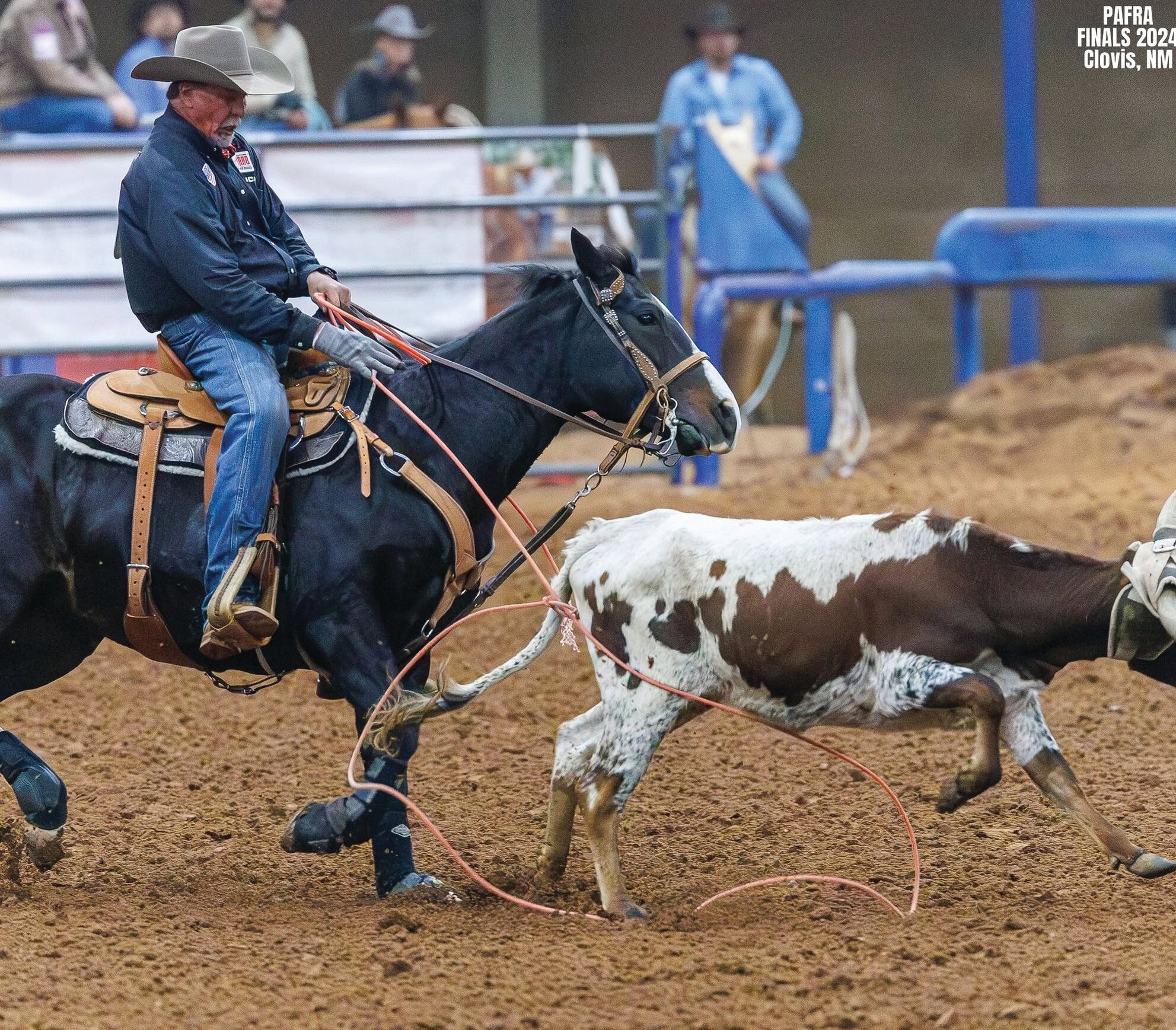
Few team ropers have spent as much of their lives in high-stakes environments as Rob Shilaikis, who served 20 years in the Air Force before spending another 20 in federal law enforcement.
“When you hear the whistle of a missile coming, your heart is in your throat for a second while you try to tell if it’s going to hit you or miss you by a mile,” said Shilaikis, 63, who enlisted in 1983 and spent significant time in the Middle East.
From Olathe to the Air Force
The Colorado native grew up working on his family’s farm in Olathe and remembers being about 10 when rodeo legend Allen Keller gave him his first rope. Shilaikis rodeoed some and worked briefly in construction before enlisting at 20.
In the Air Force, Shilaikis started as a shooting instructor and, during one of his five overseas deployments, became a member of the European Rodeo Cowboys Association. Years later, while stationed in Italy, he still had friends in the European rodeo community and once competed in a 2,000-year-old French bullfighting coliseum.
In 2000, Shilaikis, his team roping partner and a couple of other men started the Professional Armed Forces Rodeo Association.
From 9/11 to Undercover Work
Shilaikis eventually moved into the Air Force Office of Special Investigations. On Sept. 11, 2001, he was working at OSI headquarters across the river from the White House. After the attacks, his work shifted from protective-service assignments to investigating who was behind 9/11. Shilaikis flew to Guantanamo Bay and later Afghanistan and Iraq to conduct interrogations.
“A lot of us Americans complain, but the reality is that we have no clue what our nation is doing every single day to protect us,” he said.
After retiring from active duty in 2003, Shilaikis continued working with the FBI as part of the Joint Terrorism Task Force out of Denver.
During his federal law-enforcement career in California, he met Shawna, who showed horses. They married and have two daughters. Shawna also roped and is a nurse by trade and the clinical director of their local VA.
In 2011, they moved to Durango, Colorado, where Shilaikis spent the final years of his career as a special agent for the BLM. He retired for good in 2023.
“I was blessed to make it back here,” said Shilaikis, who spent years working undercover to bust drug and sex-trafficking rings.
Some cases were particularly difficult, including one in which a suspect grew suspicious during an undercover drug investigation and threatened to kill Shilaikis and his family.
Whether working undercover, serving in a war zone or roping, Shilaikis learned to focus only on the job in front of him, minute by minute—or even second by second.
“But when you see dead bodies, or you knew if something didn’t go well that people downrange were going to die?” he said. “It got overwhelming.”
The Cost of Service
Experiences like those take a toll. It’s part of the reason more than 140,000 veterans have taken their lives since 2001. The VA’s latest annual report, released Sept. 30, found that 6,488 veterans died by suicide in 2024—an average of 17.7 per day.
Shilaikis said therapy helped him through his own suicidal thoughts. But the past year was brutal. He lost his mentor, a former Marine he had lived with in California, as well as a friend from OSI who later worked for the FBI. Both died by suicide.
Veterans Crisis Line
Veterans in crisis and their loved ones can Dial 988 then Press 1, text 838255 or connect through the Veterans Crisis Line for free, confidential support 24/7.
Finding Refuge in Roping
Shilaikis met minister and heeler Trey Johnson when Johnson officiated the 1999 funeral of young steer roper Colby Goodwin. The two reconnected years later when Shilaikis attended Johnson and Charly Crawford’s Horns N’ Heroes Clinic in Decatur, Texas, for the first time.
“I ended up winning the heel end of that jackpot,” Shilaikis said. “That was really special for me. That buckle meant more to me than anything.”
Shilaikis mostly heels now, though he says he was a better header. He can rope both ends on the mare he got from his father-in-law, Dennis Klinghagen.
Today, Shilaikis still turns down offers to serve as a U.S. marshal. He counts his blessings, including surviving heart surgery as a child and, more recently, kidney cancer.
“I have a beautiful place here in Durango with my own roping pen,” he said. “The back porch looks at the mountains. I have the ultimate man cave with a wet bar that looks straight out at the roping boxes.”
—TRJ—
Thank you to Equinety for helping us share stories of military members, veterans and first responders in the team roping community .