


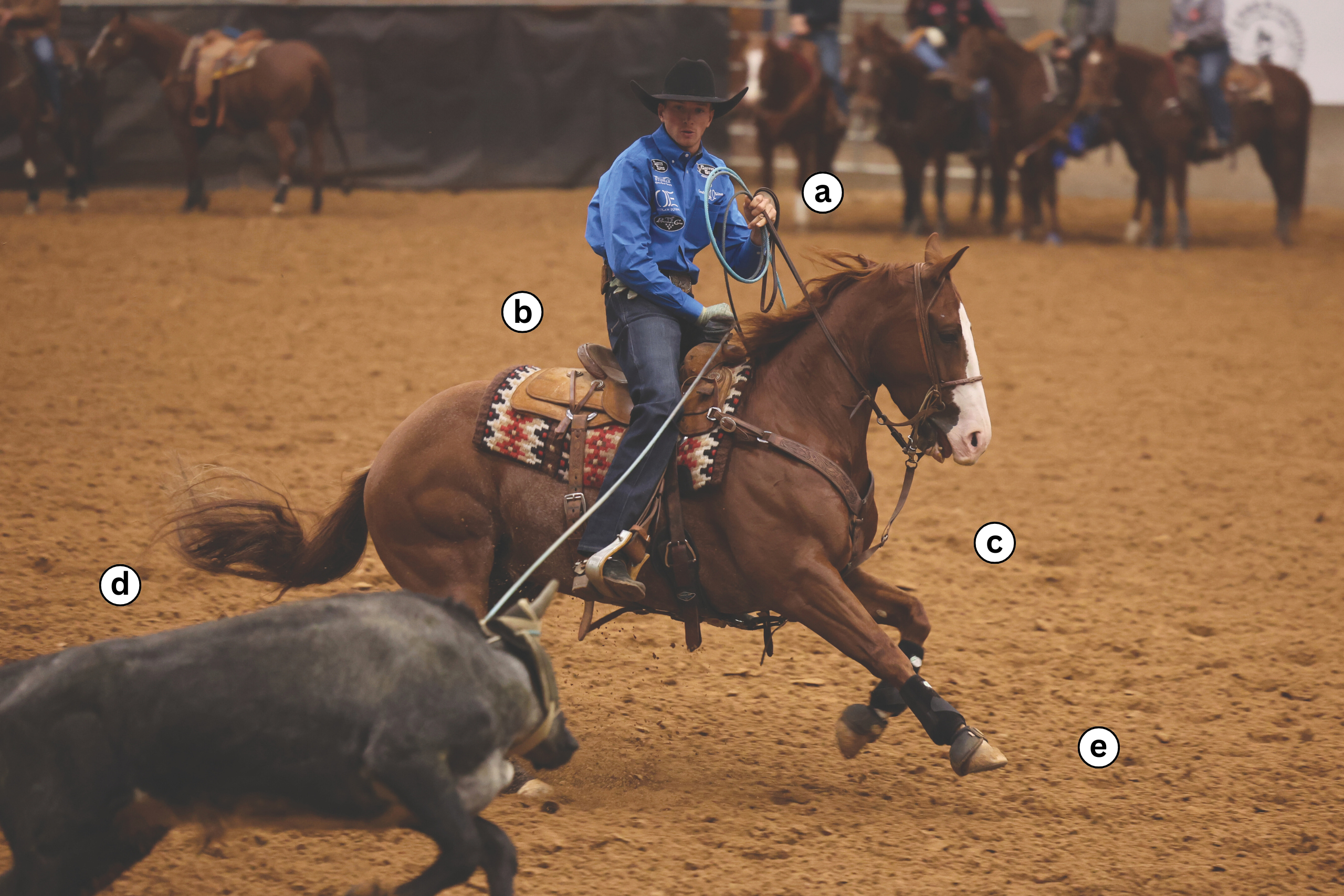
SITUATION: Clyde Bolejack and Catty Reyz in the short round of the American Rope Horse Futurity Association World Championship 4 & Under Limited Heading
PAYOUT: $16,104
SCORE: 900.33 on four
a) LEFT HAND
That horse is really cowy and still pretty green, but he understands the game plan well enough for what’s going on. He wants to be a little—for lack of a better term—droppy right there, but he doesn’t want to duck. That steer was off to the right, and when I had to move him over there to get to the steer, that’s challenging for a 4-year-old, especially one with only four or five months of heading. My left hand is basically just standing him up and getting him on his butt a little so the steer can come around me and I can set up the corner. I was still trying to show my horse, but also make it easier for my heeler.
b) BODY LANGUAGE
That horse is real feely. If you use too much leg, he’s going to overreact. With some horses, you got to use your left leg to stand them up, but with him, I’m just trying to squeeze with my legs. Right there I’m kind of up out of the saddle, but I’m still trying to squeeze him forward. I’m trying to use my body to push him forward without leaning. My shoulders are square with his shoulders because if you get to leaning, they can kind of go out from under you.
c) HORSE’S BODY
I like that his shoulders are up. I’d really like him to be on his butt a little more, and his head is straighter because I’m using a lot of inside rein right there. But that’s because he’s cowy and I have to ride him a little different than I would another horse—he wants to look at the cow but also wants to get away from it. He is in the correct lead, too.
d) HEAD CONTROL
I’ve got a pretty good hold of the steer’s head. Whether you’re showing or jackpotting, the same things still have to happen: you’ve got to get out of the barrier, turn the steer in a way your heeler can catch, and set the run up so you can finish with a good, clean face. To me, that steer is maybe fighting his head a little—he’s kind of got his head down or really off to the left. But, if I remember correctly, those steers had been roped several times. Whether they’re fresh or not, you need to have control of their head; wherever their head goes, their body’s going to go. It’s almost like you’re leading them off. You get their head, and then you don’t want to necessarily pull them, you want to guide their head and let momentum carry them around the turn. Your heeler’s kind of pushing them as well if they ride a good corner.
e) UP AND OUT
Stepping up and out in front like I am right there kind of looks like I’m outrunning the steer, but I’m stepping out in front. That’s also how I get a hold of the steer’s head. If you run too tight or stay behind, the steer will stand up, and then you get that gray area of, “OK, is the steer going to hit and shoot up the rope, or is it going to come behind the horse?” If you stay wide, keep their head and keep their shoulders moving, they really have no choice but to keep going forward. That lets the heelers follow your lead.
—TRJ—