


Situation: Royal Crown 6-&-Under Heeling
Score: 589.66 on four (590.04 on four in the Semi Pro)
Payout: $21,027
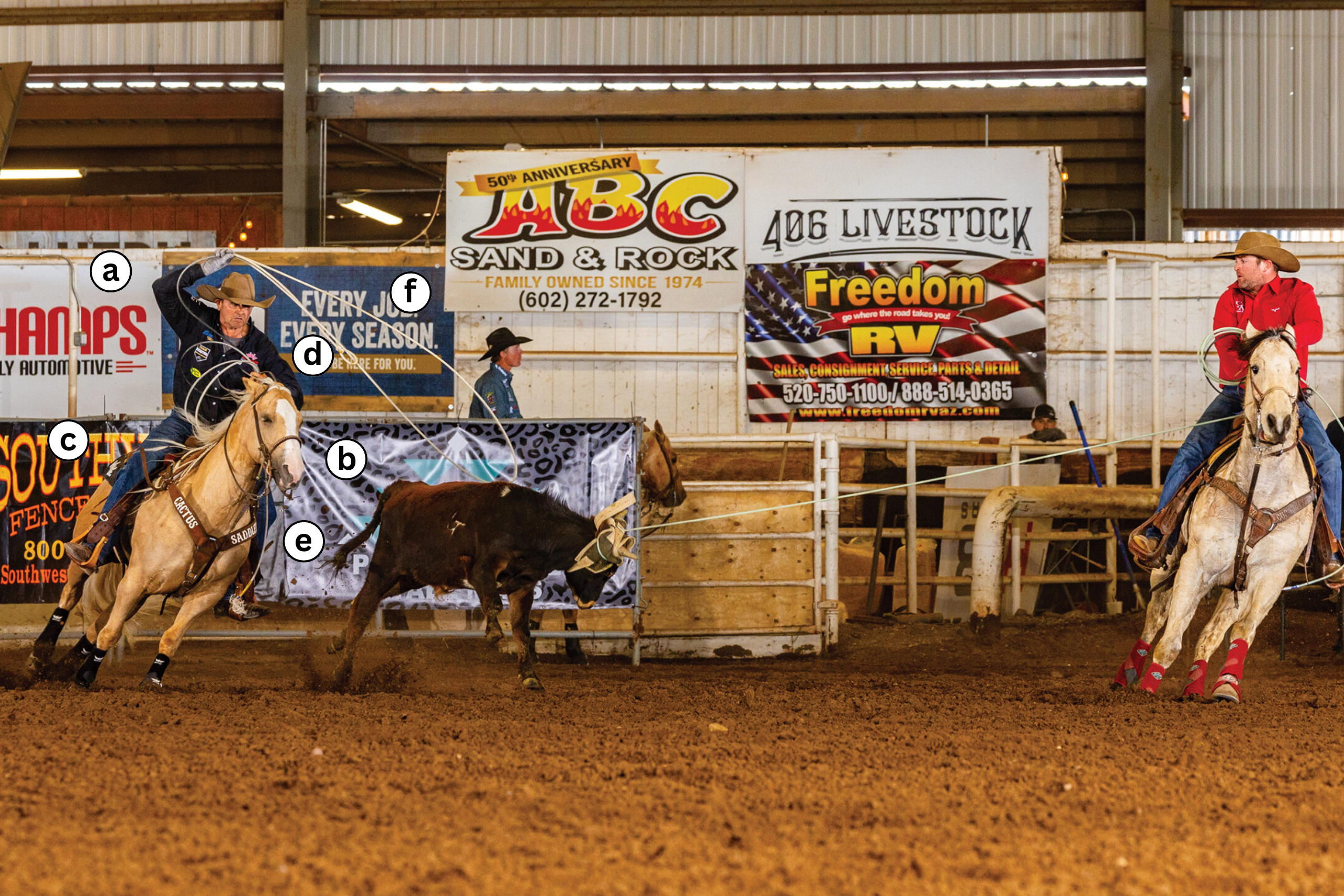
a) READING THE PLAY
All the other steers tried pretty hard and were strong, but that one was a little softer. I remember this run because my mare came off it really well. You can see my reins are loose coming around there; I’m not having to hold her in place or anything. And where we’re at in the arena, we’re a lot closer to the chute. Like I said, the others were three-quarters of the way down the arena, so I remember being really proud of her for that run because she read the steer and the situation and came off it and let us finish that run really good.
b) POSITIONING
Usually you see a relationship between the head horse, the heel horse and the steer. Everything’s connected. In this run, though, you see it a little differently because the head horse is still pretty square down the arena—he’s not too far through the corner. The steer is a little sideways, or a little farther through the corner than the head horse. Then you can see my horse kind of falling off the steer.
I think that’s just my horse really reading that steer in that spot. A lot of times, like I said, you’ll see everything kind of matched through the corner—the head horse, the steer, the heel horse. Clayton did a good job of standing up and getting ahold of that steer soft right there, because it was a softer steer, and getting him picked up real nice and on the end of it.
At first glance, it might look like my horse is diving in there, but the more I looked at the picture, I was like, “Well, I’m on a loose rein.” The way her body is positioned, it might look like her left shoulder is dropping, but she’s actually pretty balanced. I’m not holding her head, I’m sitting up in the middle, and with where the steer is hitting, it’s just going to roll forward. I’m able to push around to it and set everything up right there.
c) PALE LIBERTY
She’s real aggressive. That’s why it’s cool to see her on a loose rein in this photo, because she’s aggressive down the arena and around the corner. I always have to work on keeping my distance in the corner and leaving room—that’s something I concentrate on when I ride her. So her reading that steer on a loose rein meant a lot on that run.
@teamropingjournal 2020 Mare Pale Liberty + @Cactus Ropes man @Andyholcomb = Royal Crown 6&U Heeling Champs in Buckeye in 2026. PALE FACE DUNNIT x LIL MISS PEPTO x PEPTOBOONSMAL 🎥 @Audrey_TheHartBrand
♬ original sound – whatthefckisupsahl
d) LOOSE REIN
When you’re pulling on a horse, you’re taking their attention away from the cow and onto you. That can be a good thing, or it can be a bad thing. Right there, I picked her up when the head rope went on. Then I gave her head—not just putting my hand down on her neck, but giving a little slack in the reins and letting her read the cow.
You’ll notice cutters don’t pull their horse’s face because they want the horse to pay attention to the cow. So, in a similar way, when we want a horse to read and pay attention to a cow, if we’re pulling on their face, they’re thinking about us and not the cow. By giving them their head just a little or picking up and slowing down and giving their head back, we can let them keep their focus on the cow and their job.
e) FEET + LEGS
This mare’s pretty aggressive, so I usually don’t have to push her very hard, if at all. I tend to ride with my heels down. Looking at this picture, my heels are pretty down, pretty level. I probably used a little inside leg to help her hold out around them. From there, it’s just however she feels. She’s leaning a little to the left, so I might use a little more left leg. If I need to square up more to that steer, I’ll use a little more right leg. That’s really just a feel thing for each person and how a horse is balanced as they’re traveling.
f) HEEL LOOP
I’ve been working on something Kollin (VonAhn) and Shay (Carroll) told me—not to turn my rope over to the left side of my horse. I head, too, and whenever I head, I point my index finger where I’m going to turn over the rope, which is usually the outside of the right horn. When I heel, they told me to grip it and not point my index finger.
Looking at this, I have my index finger tucked in and I’m pulling the rope across the steer’s back to the left side of my horse before I turn it over. A lot of times, I would be turned over on the right side of the steer right there, or the right side of my horse’s head, whereas here, I pulled across and then turned it over on the left side of my horse’s head and the left side of the steer’s body.
In essence, it’s kind of like pulling the rope across the steer’s back. It’s down over its back, but then it’s pulling across his back. That’s something I’ve really been working on, and it’s going to bring your tip, your bottom and everything together when you deliver.
—TRJ—
READ: Heelers Only: Royal Crown Champs Holcomb, Brazile and Buhler