


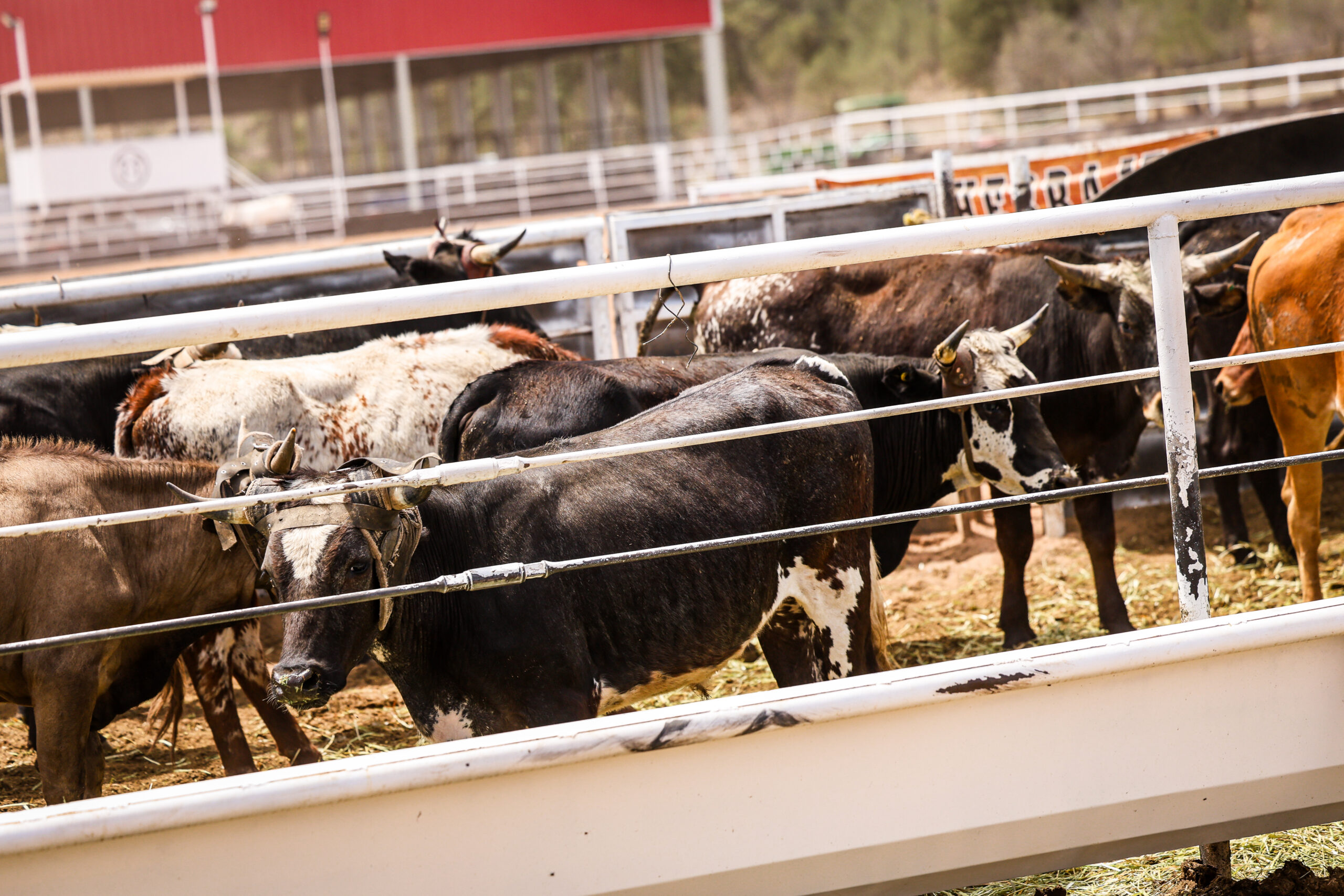
The U.S. Department of Agriculture will reopen the Douglas, Arizona, port of entry to Mexican Corriente cattle on Aug. 24, the first movement on a border closed to livestock since April 2025.
No cattle have crossed yet. The futures market has already responded.
Feeder cattle futures opened sharply lower the Monday following the announcement, with contracts from October forward closing down the $10.75 daily limit. The CME Feeder Cattle Index fell 4 percent over the week. Across the previous three weeks, the fed cash market dropped roughly $30 per hundredweight.
Jackie Moore said that number is the one ropers should be watching. Moore runs Joplin Regional Stockyards in Missouri, markets about 570,000 cattle a year out of the one location, and ropes.
“Roping cattle, they’re going to follow the beef cattle, no matter what they do,” Moore said. “We lose $30 a hundred off an 800-pound steer, that’s $240 a head. They’re going to just follow what the beef market does, more or less.”
If the beef market gives up $200 a head on the reopening, Moore said, he expects roping cattle to give up roughly the same.
He also disputes the premise that roping steers have been an outlier.
Still to come: Where does the NFR cattle situation stand
“Everybody talks about how high roping steers have gotten,” Moore said, “but really and truly, they’ve not went up any more in price than the beef cattle have.”
The Beef Market Behind the Price
The U.S. cattle herd is the smallest it has been in roughly 75 years. Beef demand has held through record retail prices.
Moore said the closure landed on a market that was already short.
“We’ve been real short, and the demand’s been really good,” he said. “When they shut the Mexican border down, they just added fuel to the tank.”
USDA and industry projections put Mexican crossings in the range of 80,000 to 100,000 head over a year once ports are fully operating. Moore said he doubts the number gets there, and that the figure is smaller than the roping industry may assume.
“I market 570,000 cattle a year at one spot,” he said. “It’s not as big a deal as everybody wants to think in their mind.”
Background: Understanding the Mexican Border Closure
He said he believes the trade has changed shape during the closure, with Mexican operations building out feeding and processing capacity rather than waiting on the gate.
“I think the people in Mexico have figured out how to fatten those cattle, to process those cattle and to export the meat into the United States,” Moore said. “I think we’re getting a lot of that meat anyway.”
Oklahoma State University livestock economist Derrell Peel has written that the market impact of the announcement should be minimal beyond the initial futures response, and that the flow of Mexican cattle will be very small for many weeks.
Feeder cattle move by the tens of thousands a month. Roping cattle, by industry estimates, move a few thousand in a year.
What Producers Say They’re Facing
Steve Simons has produced ropings since the late 1990s. He runs World Series ropings across California and supplies rodeo cattle to PRCA rodeos in the state, along with events in Oregon and Washington. His World Series ropings average 400 to 500 teams and run a single day to hold overhead down.
“The border opening is a double-edged sword,” Simons said. “The front end’s going to go up and the back end’s going to go down.”
On the front end, Simons said he expects fresh M-branded steers to cost $2,000 to $2,200, and he expects that range to function as a floor.
“Every time they say that, that means the opening bid on the cattle is probably going to be $2,300,” he said.
He said the number he watches is not the price of a fresh steer but what he has to add to a worn-out one to replace it.
“I always told myself I could put $150 with an old steer and buy a new one,” Simons said. “Lately I’ve been putting $500 and $600 with an old steer and buying new ones.”
On the back end, Simons said used roping steers are carrying an unusual premium, which he attributes to the beef shortage. Packers are short enough, he said, that old roping steers are getting their horns knocked off and killed domestically. In a more typical market, he said, those cattle cross the other direction, get killed in Mexico and return to the U.S. as boxed beef.
That premium is already coming off, according to Simons. He said the last set of seven-weights he sold in California brought $2.27 a pound, and that the same cattle today, on speculation alone, are $2 or below.
“That’s losing $210 a head,” he said.
He walked through the arithmetic. At $2 a pound, a seven-weight brings back $1,400. Against $2,200 on the front, he said, the first $800 is gone before feed, medicine or death loss. Add another $125 to $150 a head in feed, and a steer has to generate $1,100 to $1,200 to break even. Some cattle, he said, give three or four runs and they’re done.
“The spread between what we get for our old cattle and what we’re having to pay for the new cattle is going to be too much for a lot of producers to stay in the game,” Simons said.
For rodeo cattle, he takes the math out to a per-head charge. He said he aims for about 14 runs out of a bulldogging steer in a season, which pencils to roughly $100 a gate. Producers getting 30 runs out of their cattle, he said, can operate in the $50 to $60 range.
“I just think breaking even on these cattle when this border opens is going to be a lot tougher,” he said.
Simons said he still wants the border open, and named the price he thinks the market needs to reach.
“I’m excited the border’s opening,” he said. “I think these cattle need to get off this $2,200 deal. We have to be down around $1,500, $1,600.”
Buying Cattle Without Imports
Simons said the hardest part of the closure was losing the ability to buy in volume.
“When the borders are open, we can call them,” he said. “We might not like the price, but we can order one or two truckloads of steers, and as long as you’re willing to pay for them, they come.”
Instead, he said, he has assembled loads a piece at a time — 42 steers out of Vale, Oregon, another 16 out of Terrebonne. Partial loads raise freight per head, which he said lands on the cattle cost.
He also described a safety cost. With M-brands unavailable for steer wrestling, used roping steers came into the mix, and Simons said the men breaking those cattle had to put substantially more runs on them before they were safe for competition.
“If they’re fresh cattle, we just throw them down and they go right to work,” he said.
Simons is still hauling all M-brands for his bulldoggers. His team roping cattle are all natives.
Natives and M-Brands
Both Simons and Moore said the M-branded versus native question is usually framed around origin, and that origin is not the variable that matters most.
Simons pointed to age and to where cattle are raised.
“I don’t think there’s a lot of difference between a native and a Mexican if they’re the same age,” he said. “The problem is, out here in California we have such lush feed, you’re able to rope our natives at eight to 10 months. Same as Oregon, Washington, Idaho.”
Desert-raised cattle out of Nevada and Arizona, he said, get roped at 17 or 18 months.
“That’s a different animal,” he said.
Simons said M-brands still hold up better in his operation because they carry more age, and he said domestic breeders have done a phenomenal job.
Moore’s variable is uniformity within a set.
“Whatever they are, they just need to be even,” Moore said. “If I got one that runs and one that walks, I got a problem. Then it becomes a drawing contest. That’s not the way it should be.”
Moore also said the horses ropers are riding have changed what they can handle.
“We keep upgrading our horsepower,” he said. “We’re crossing back on these race-bred horses and we’re getting a more superior animal than we’ve ever ridden before — faster, more athletic. We’ve got the horsepower to handle the natives. If we went back and rode the same horses we were riding 30 years ago, we’d have a lot of trouble.”
Herd Numbers and the Supply Ahead
USDA put the 2026 calf crop at 32.5 million head, down 1.5 percent from 2025, a decline of roughly 500,000 head. Heifers made up 37.38 percent of cattle on feed in July, the lowest ratio for that month since 2018, a figure economists read as the start of herd rebuilding. Retention pulls animals out of the feeder supply before it adds calves back.
Moore said rebuilding is constrained by labor as much as by price.
“The people that want to calve those heifers and work that hard and go out in the snow and the blizzard, there’s a lot fewer than there was 30 years ago,” he said. “People don’t want to do that type of work anymore, and you can’t hire anybody to do it either. We can’t rebuild this cow herd very fast just because we don’t have the actual people out there to do it.”
Moore, who is 67 and has spent 50 years in the business, said land is a second constraint. He said ranches increasingly sell to buyers who don’t depend on cattle for income, and more recently to data center developers. Ground worth about $4,000 an acre to another rancher, he said, is drawing offers near $26,000.
“How can you tell the guy not to sell his ranch?” he said.
The Crossing Process
Under the USDA protocol, every animal crossing is inspected individually. Cattle must originate in approved low-risk regions of Sonora or Chihuahua, be screened and treated by a Mexican veterinarian, and be held in certified pre-export facilities for three to five days. Any animal with a visible open wound is barred from export. USDA veterinarians examine every head at the port, and cattle move through a pesticide dipping vat before crossing.
Miguel Guerrero of Las Tunas Cattle Co. in Chihuahua, one of the larger suppliers of roping cattle to the U.S., said the pipeline runs about a month. Tuberculosis and brucellosis testing takes roughly 20 days to clear, he said. Only then does an operation get a port appointment, and cattle sit through inspection at the border for another three to four days.
“It totally takes about 25 days to a month to be able to cross, once the vets visit your facility to make the test,” Guerrero said.
Douglas sits on the Sonora line. The ports serving Chihuahua—Santa Teresa and Columbus, New Mexico—have no announced date. USDA has said it will consider them after evaluating the Douglas opening.
Guerrero said he expects congestion.
“All ports are going to be saturated,” he said.
Cattle held in Mexico through the closure also kept growing. Moore said he expects a share of them are no longer usable for the sport.
“A lot of those cattle got too big, so they went by the wayside,” Moore said. “That’d be my guess on a pretty good percentage of them.”
Guerrero said cattle that outgrew the sport at Las Tunas went to the Mexican consumption market.
What Could Change
USDA said the reopening timeline “will remain flexible,” and that openings “may be paused” if post-opening audits turn up increased risk in Sonora or Chihuahua. A reopening announced in 2025 never took effect.
R-CALF USA opposes the phased approach and wants the border closed until screwworm is eradicated in Mexico. The National Cattlemen’s Beef Association and the Texas & Southwestern Cattle Raisers Association welcomed the announcement in measured terms.
Moore said the market has been reacting to the conversation as much as to the facts.
“So much of this is a response to the media, just the hype of the whole thing,” he said. “If everybody didn’t say much of anything, probably nothing would happen — the market would be just fine. But everybody wants to react one way or another, and you never know how they’re going to react.”
The Team Roping Journal will report the Santa Teresa and Columbus announcements, and the first crossings at Douglas, as they occur.