


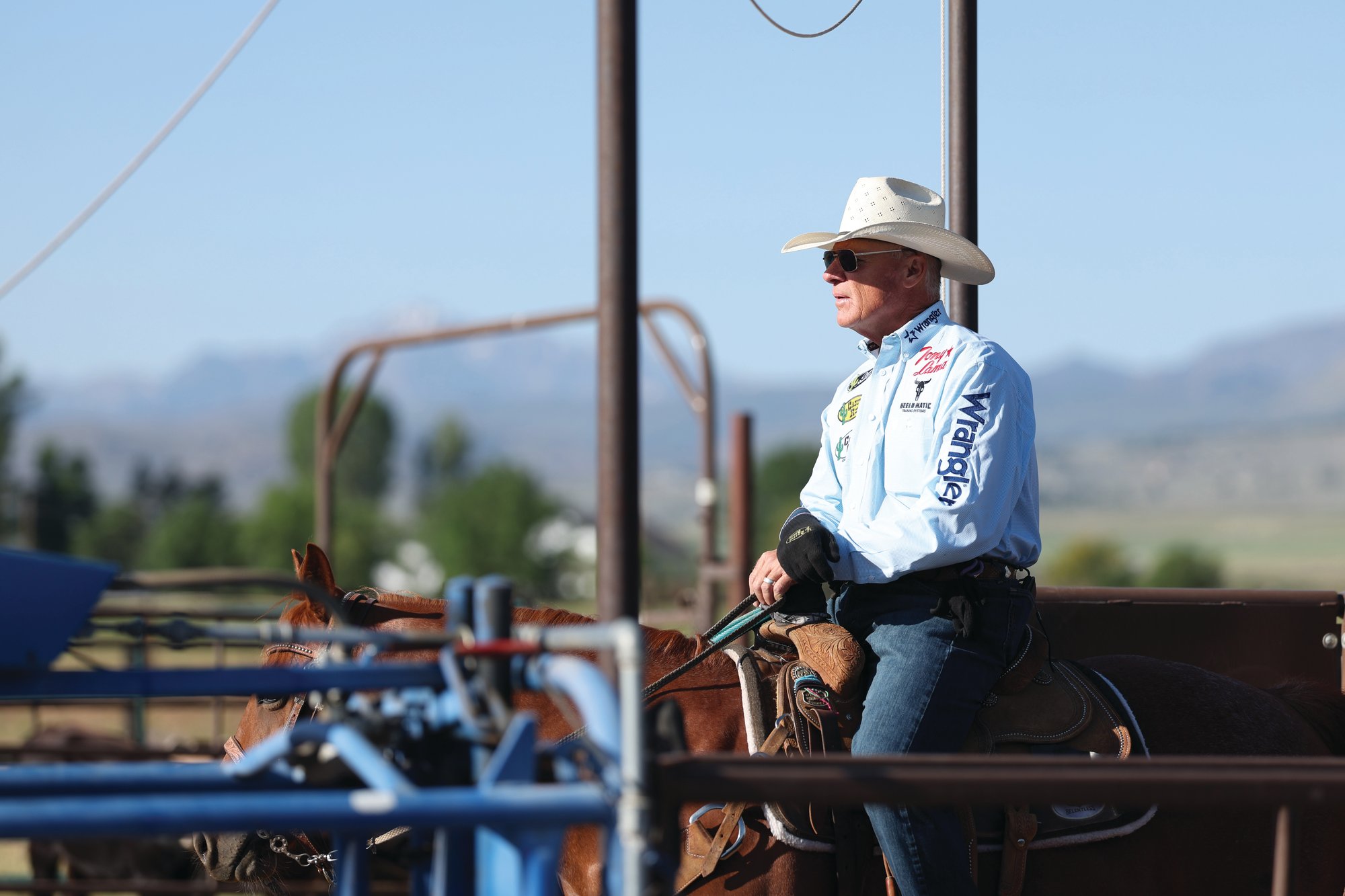
For me, the last 55 years have been a process of daily evaluation and thought about my craft, which is heeling steers. I now head a little bit, too, so that’s an addition to the process.
Build the Habit in Practice
It all starts with preparation and coming up with a plan based on what you think you and your horse need. That might mean working on your fundamentals or pinpointing a certain area of your roping to focus on, or working on a horse that needs a certain type of run that day.
This process builds your ability to react and evaluate things as they’re happening. You’re trying to get a desired outcome, and by the end of the day you want to achieve the goals you set for that day. It’s also helpful if you can get video, because it doesn’t always look the way it feels and videos don’t lie.
Make a Game Plan Before You Compete
This daily process builds your ability to focus. Then, when you transition to competition, you build a game plan from it. Those are going to be the preloads in your mind—a plan and goals for what you want to accomplish at that competition. Take into account everything you can think of—arena conditions, ground conditions, the type of cattle you’re going to rope, who you’re roping with and which horse you’re riding.
The game plan might be a little different with each partner. Are you going to rope on the conservative side or the aggressive side? Watch the cattle and really pay attention to the oddballs that slow up, run hard or duck their heads. That can be helpful in the next round or the short round.
Know What You Need Before You Nod
When you get to the short round, remember that that’s what you’ve battled for all day. It’s just one more run. Being able to evaluate that short round—things like who’s in it and what position you’re coming back in—plays into your game plan for that last run. Evaluate it all, because it keeps your mind engaged in the competition.
More than half the time, the battle is won or lost in your mind when you ride into the box. I try to stay on top of that, because I hate making mistakes. Sometimes I look back and wonder why I didn’t pay attention to a certain factor that would likely have changed the outcome in my favor.
I went to a roping last week where I watched a lot of talented young ropers compete. Some needed more strategy to execute a pretty easy run to win money. It was kind of mind-boggling to me because of how my brain is trained to work, which is to evaluate every detail to give myself the best chance to win. To see people who are oblivious to this process I’m talking about here, which would help them win so much more, is wild.
Don’t Leave Money on the Ground
Learn how to evaluate the situation and make a plan before you ride into the box. Notice every detail—whether a steer has big or small horns, is high-headed or low-headed, is slow or fast. Use that information to your advantage. Nine times out of 10, the battle is won or lost in those simple things that are obvious if you know what to look for.
Trying to be 4 when you just need a time to win money is not thinking. In that scenario, there’s money lying on the ground. Run up there, stick your boot in his butt and stick money in your pocket.
Our world has changed so much. When I was a kid learning how to rope, I had to use so much more of my imagination than kids do today, because we didn’t have all the technology we do now when I was their age. I can still see Leo and Jerold Camarillo, Walt Woodard and Ken Luman heeling steers in my mind like it’s a video. It’s all handed to us now on our iPhones, but people still need to think.
Having to use my imagination made me more detail-oriented. I looked for every little thing and recognized its importance. Rodeos didn’t pay like they do now, so every dollar you won with your rope was important. I had to win to pay my mortgage and truck payment, and I had to be on top of every detail to get that job done. Call it old school, but I think it was an advantage.
—TRJ—