


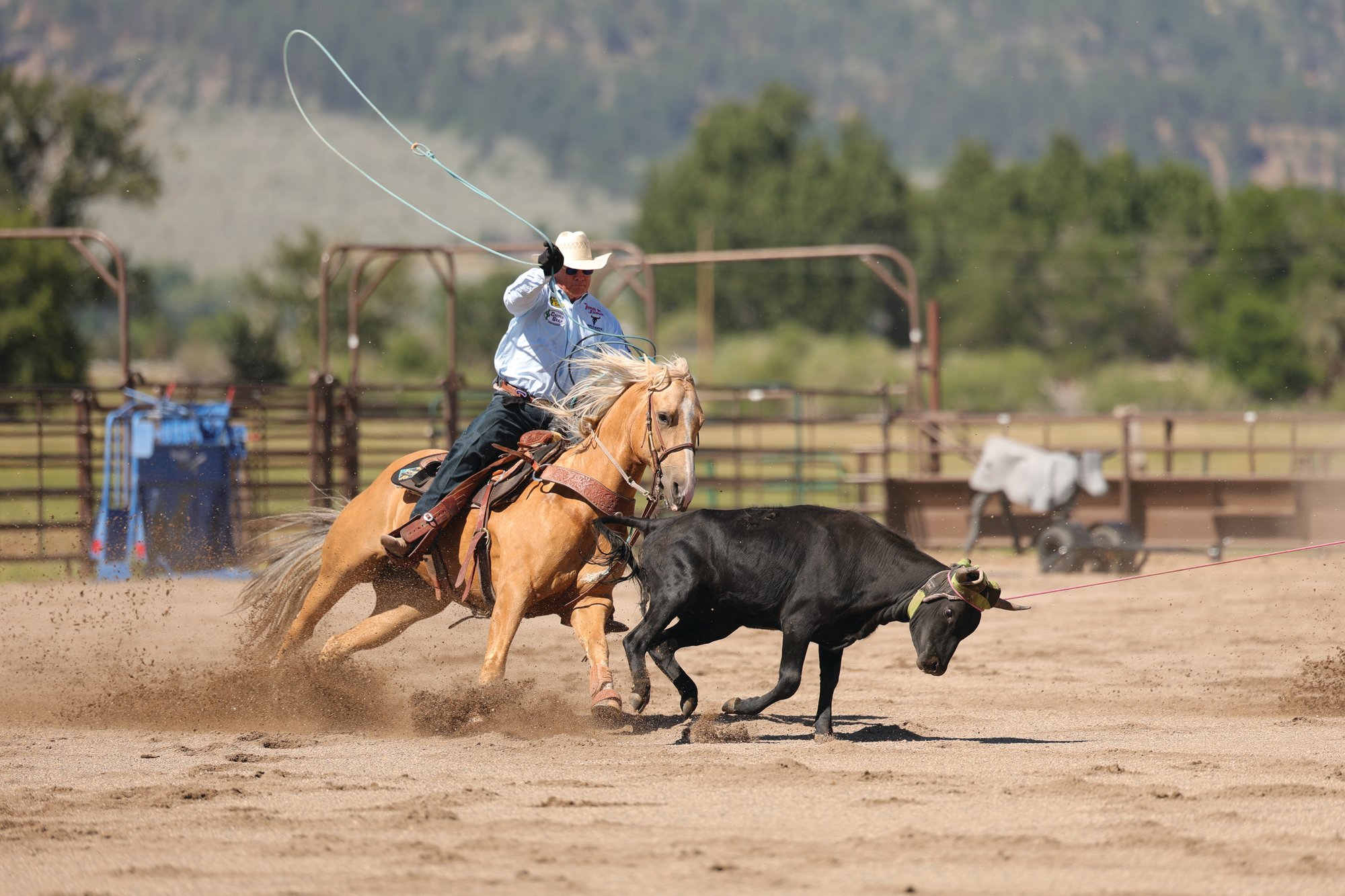
The unique thing about heeling, which makes it different from heading and calf roping, is that you’re trying to set up your shot in or right after the turn. There’s some riding going on there that needs to happen to make it all work.
We sometimes see low-numbered ropers just kind of ride their horses into the corner with their momentum going down the arena. There’s this free energy going down the arena, but then when they start to turn the corner the message in the horse’s mind changes. There’s a mental message transfer for that horse, and now he’s starting to look for when he’s supposed to stop.
Less experienced ropers typically throw as their horse turns in and squares up, whether they’re in time and see the shot or not. They’re just kind of throwing at the end of that free ride.
It’s kind of like a domino effect, because the pattern that sets up leaves them roping too much on separation. They just throw and go to the horn, because there’s not enough time to pull their slack with the steer leaving and the horse stopping.
I learned years ago to catch two feet consistently. In doing that, I learned real quick that I had to ask my horse to go with the steer, which meant me riding him through the corner until I could get my swing timed up and my shot lined out. I figured out fast that I couldn’t stop riding my horse to make it happen.
As we continue to climb the ladder, we learn how to multitask and coordinate our riding and roping together. That’s basically what heeling is—doing several things at once. Recreational ropers sometimes segment their process. They’ll ride until they start getting to the place where they have a throw, then stop riding to think about roping.
But that causes their horses to start shutting down and stopping too early, and they have to rope with the steer too far out in front of them. Too much separation causes their success rate to suffer.
The pro guys control when their horse stops. They’re good at multitasking. They can ride and rope at the same time, and they make their horse stay with the steer until the loop is coming in for the catch. Their horse doesn’t come to a complete stop until they’re pulling their slack.
People don’t realize how much riding is involved in roping. If you don’t keep your horse moving as you’re throwing your rope for the catch, it’s easy for your horse to stop too quickly and too suddenly.
The generation of heelers before me perfected roping steers by two feet consistently. It’s because they rode through the corner good, and rode their horses until they saw the timing of their shot clearly. Roping has progressed to a faster game on both ends, heading and heeling. But those old principles still apply. If you just get to the corner and throw, you’re not going to be as consistent as the guy who can keep riding his horse until that loop is down there in position.
I always say heading is the hardest job in rodeo, because headers have to do so many things to set up the run. But heeling might be the hardest one to learn when it comes to all the little components that put it all together as a consistent pattern.
I grew up learning how to just catch first. That made me ride my horse to get consistent. Even for kids today, they usually start out at the jackpots, which is more of a consistent style of roping. They learn to go catch first. Then once they’re good at that, they learn how to speed it up.
For the few who choose rodeo as a career, there’s a whole extra learning curve to this. Because now you’re having to bounce back and forth between a jackpot run and a rodeo run. In the turn and as a steer starts to square up, there are two to three strides there, and there’s the consistent shot versus the rodeo shot on the first or second hop.
Learning how to formulate your strategy for setting up your shot based on what kind of competition you’re in is one of the finer points of heeling. Like everything else in life, how far you choose to take it is up to you.
—TRJ—
READ MORE
READ MORE: Choosing the Right Heel Rope
READ MORE: Rebuilding Your Roping with Jade Corkill