Pressure has always been a privilege for Travis Browne.
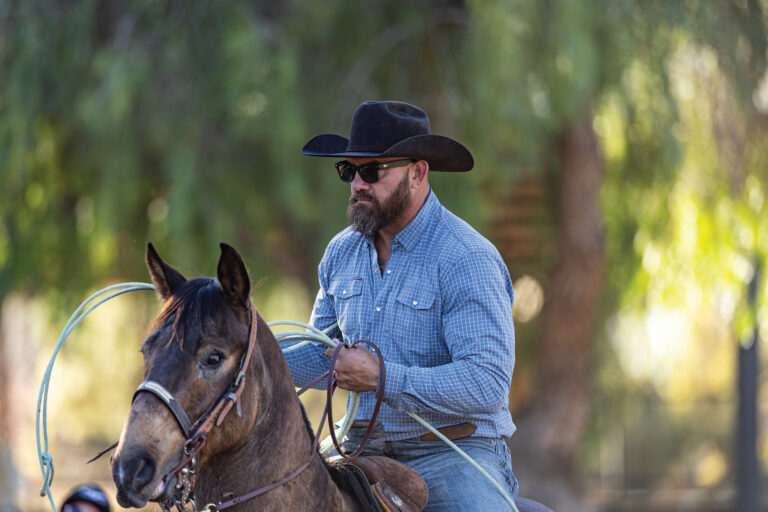
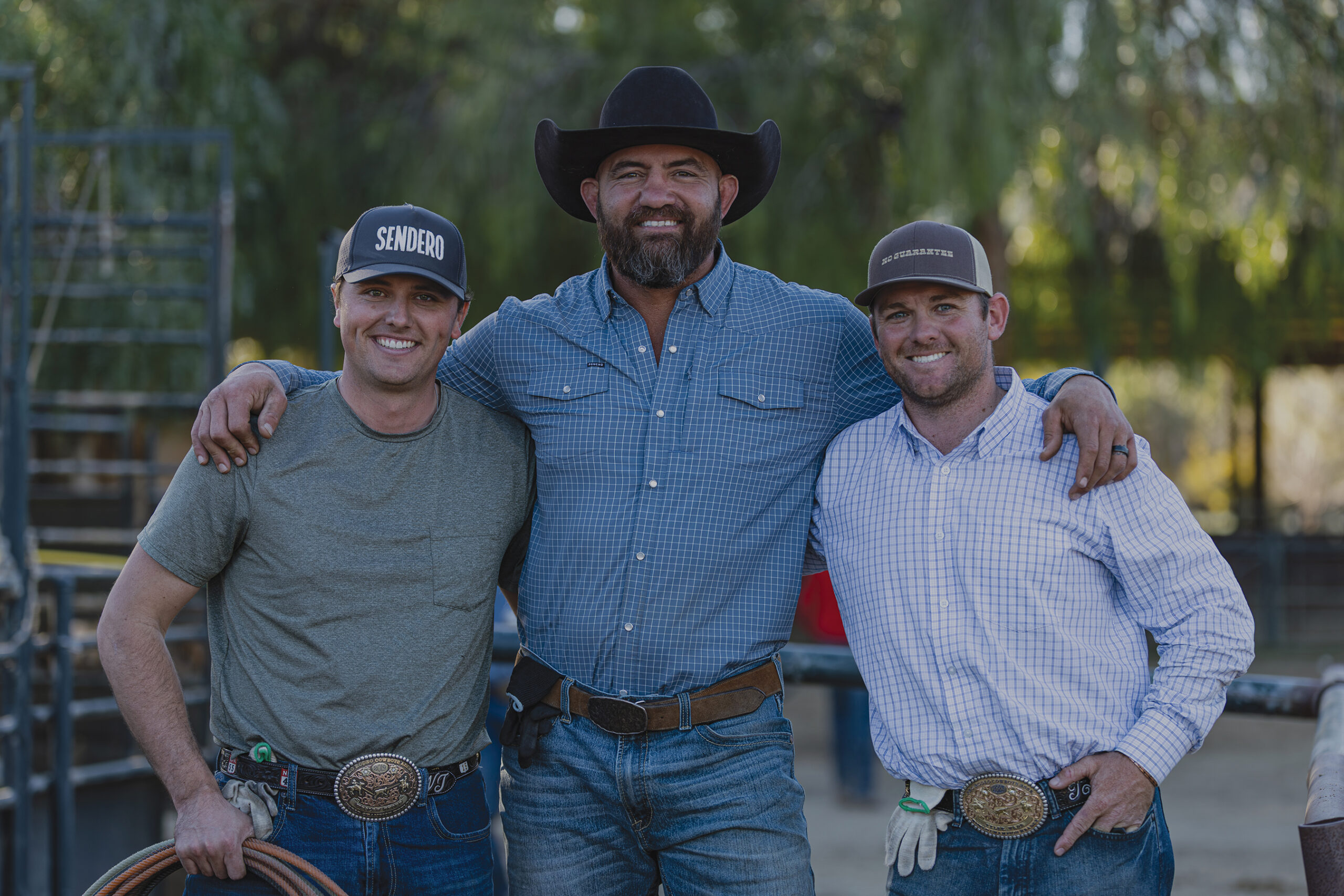
That’s what the 6-foot-7 Hawaiian says, anyway, as he’s backing into the box in Temecula, California, unfazed by this magazine’s camera, while two-time World Champion Tyler Wade coaches him from the sideline. Browne is at a roping school with Wade and Wesley Thorp this January—his third major clinic in his first 15 months in this sport—and he’s soaking it all in. That’s what he’s always done, really.
Browne, 43, didn’t start training in MMA until his mid-20s. Within a few years, he was in the UFC. Within a few more, he was ranked near the top of the heavyweight division. The rise was quick, powered less by flash than by his ability to absorb coaching and apply it at speed. He retired at 35 and turned toward ranch life—raising cattle, working brandings, learning how pressure moves cattle. Team roping wasn’t a publicity pivot. It was the next skill to study.
“When I back into the box, I’m staring at those horns thinking, ‘I’m going to rope the shit out of those horns,’” Browne laughed. “I’ve fought in front of millions. Backing into the box is fun.”
Humbling Beginnings
Browne and his wife, former UFC Champion Ronda Rousey, decided they wanted to raise their own beef at home in Southern California.
“After the first time we ate it, it changed everything,” Browne said. “It was better than anything we ever bought from the store. It was life-changing.”
With raising cattle comes branding, and while Browne was undoubtedly great help on the ground, he couldn’t help but get the itch to drag calves to the fire himself.
“Those guys are real cowboys,” Browne said. “They’d rotate from riding to ground crew, and I thought, ‘I don’t want to just be on the ground the whole time. I want to do that.’”
So Browne bought a horse, and he started to learn to ride and throw branding pen loops.
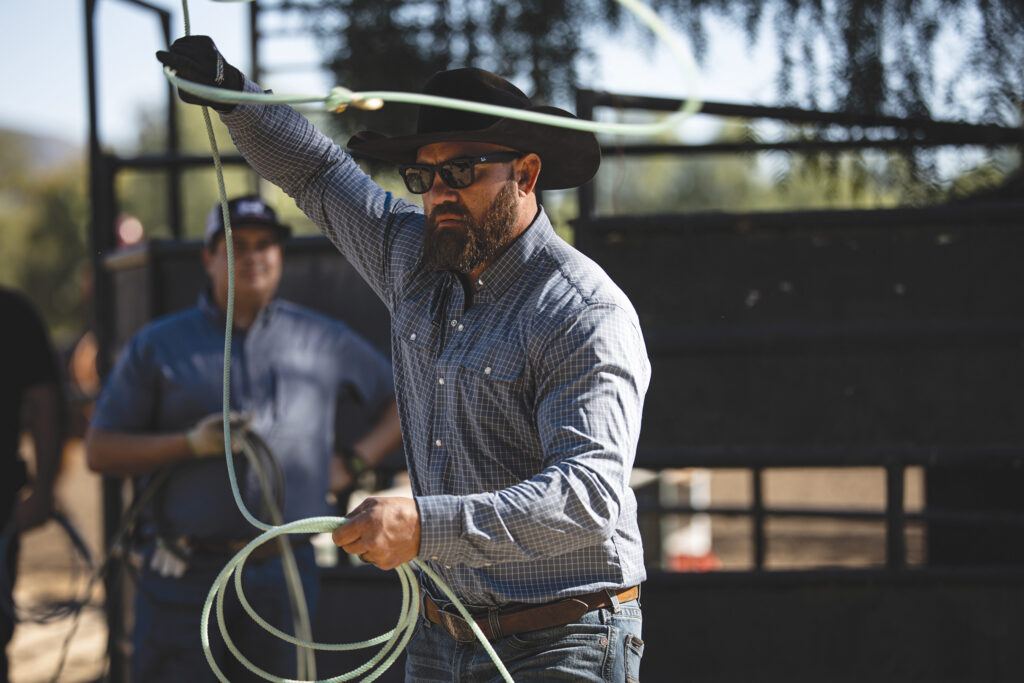
“After a while, I got good at catching calves,” Browne said. “But our ranch was in Oregon, and we lived full-time in Southern California. There wasn’t much else to do with a horse down here, so in October or November of 2024, I went to Sissy Barnes’ in Nuevo, California, and she helped me learn how to rope and ride so I could start to team rope.”
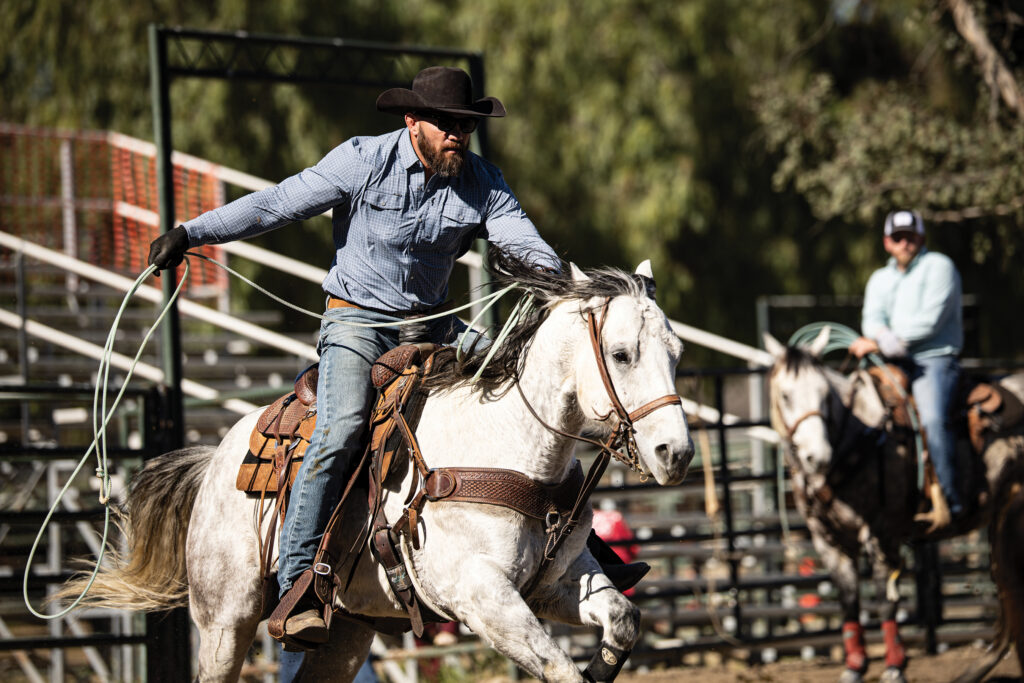
Browne’s first horse, Jugs, was a head horse before he bought him. So the first time Browne got in the head box, the horse knew the play. Browne did not.
“When the gates opened, he took off and almost flung me off the back,” Browne said. “I was like, ‘Oh my gosh, that was so much fun.’ I didn’t even have a rope in my hand. I was just following the steer. That showed me how much power these horses have and how fast the sport goes.”
But when Browne tried to pair swinging a head rope and riding his horse out of the box, it felt as challenging as patting his head and rubbing his stomach at the same time. He was just working on staying on and swinging his rope, and for the first few days, he couldn’t get one captured. But with Barnes’ help, he eventually turned his first steer.
“That was it,” Browne said. “I was done—I loved it.”
He loved it so much that on January 4, 2025, he entered his first jackpot. He’d only been turning steers for about a month at that point.
“I had no idea what I was doing,” Browne said. “I asked Sissy to go with me because I didn’t even know where to sign up or warm up. Then I missed my first three steers. On the fourth, I thought they called my name, I went into the box, and people yelled at me that it wasn’t my turn. That rattled me even more.
“I missed all four and went home feeling like an idiot. But it didn’t stop me.”
Hammer Down
Browne went straight back to practicing.
“If other people can do it, I can do it,” he told himself.
A month later, he tried his hand at another jackpot, and he won sixth, worth $400.
(For perspective, there was a time when a win inside the Octagon meant a six-figure check. In team roping, Browne is thrilled to cash a few hundred dollars and a handshake. The difference isn’t lost on him. It just doesn’t matter.)
“I was so proud,” Browne said. “I came home telling my wife we were going to buy a trailer and do all this. She laughed at me because it was only $400, but for me, it meant something. That’s when I was really hooked.”
Fine Tuning
Browne was getting the horn-catching part down pretty easily. As most team ropers know, though, he had more to refine.
“Horsemanship is the hardest part for me,” Browne said. “The roping I’m getting down pretty easy. But working with your horse and knowing how to push the buttons—that’s a whole different thing.
“For a while, I was using the reins to balance. I didn’t even realize I was doing it. But that means you’re pulling on your horse, and then you’re pissing your horse off. Then he’s blowing up in the box and causing all these problems, and it’s all because I’m yanking on him. I’m 6-foot-7, 260-something pounds. If I’m pulling on a horse, he feels it.
“Animals humble you real quick. Just because you’re good at one thing doesn’t mean you’re good at everything. And that’s what I love about this—no two runs are the same. Somebody told me there are five heartbeats in team roping—the two riders, the two horses and the steer. Nothing’s ever going to be exactly the same. That’s the challenge. That’s what makes me want to get better.”
That’s where Browne’s old-school UFC mentality kicked in. He needed a coach. Enter: 10-time NFR header Charly Crawford.
“When Charly came out, that was huge for me,” Browne said. “I was having a really hard time figuring out how to turn a steer and make it smooth and catchable for my heeler. I could catch one, but that doesn’t mean the handle’s good. And if the handle’s not good, your heeler’s chasing all the way across the pen and you’re 10 or 15 seconds anyway.”
Crawford’s systematic approach to team roping hit home for Browne. And Crawford’s ability to see small details helped Browne identify points to improve.
“He truly loves this event,” Crawford said. “The man has fantastic hand-eye coordination, and I’ve never seen anyone more coachable.”
Pressure Reframed
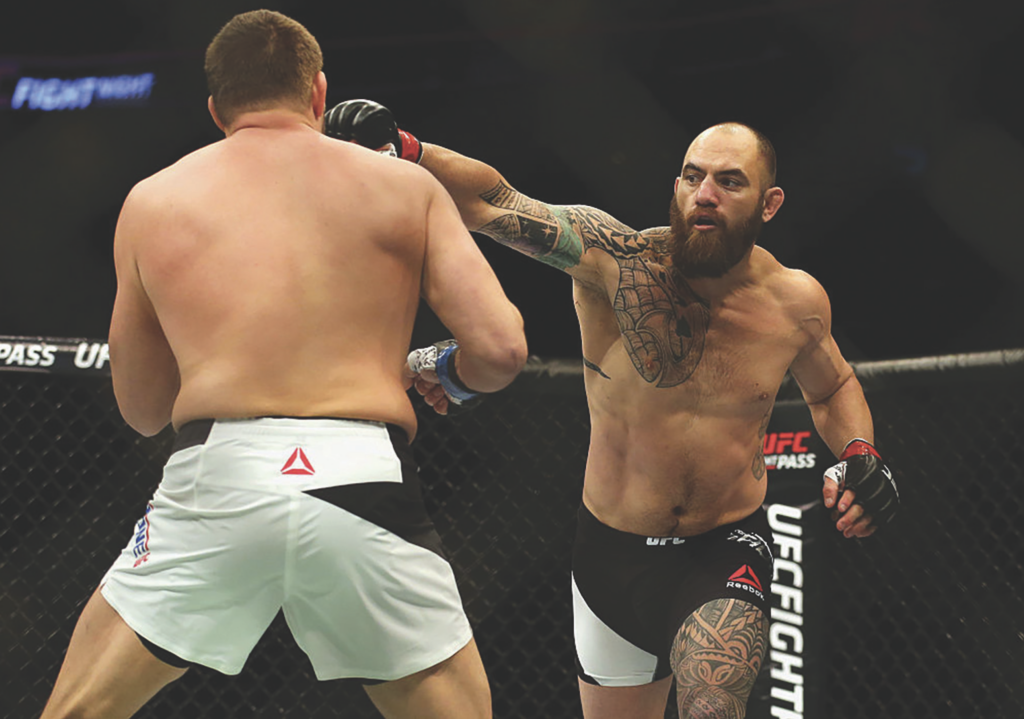
For most of his fighting career, Browne stepped into arenas with a singular objective: be the best in the world. There was no gray area in that pursuit.
“When I was fighting, my goal was to be the best in the world,” Browne said. “I came up short.”
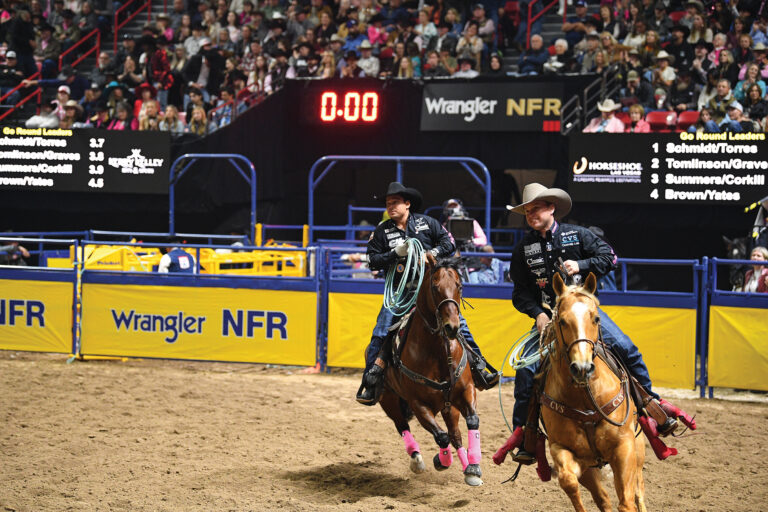
Team roping doesn’t carry that burden. Even at the Ariat World Series Finale in Las Vegas—where Browne roped for the first time last December—riding down the tunnel, hearing the crowd through the walls, feeling that familiar chill run up the back of his neck—the pressure felt different.
“It kind of reminded me of fighting,” Browne said. “Standing in the back, hearing the announcer, the crowd. But this time I got to take it in. When I was fighting, I couldn’t really absorb it. I had one goal—beat the guy across from me. Now I get to enjoy the moment.”
That shift is deliberate. Browne isn’t chasing a gold buckle or a ranking. He isn’t trying to rewrite his competitive résumé.
“I’m not trying to win the NFR,” he said. “I just want to get as good as I can get.”
The adrenaline is still there. The intensity hasn’t faded. But the objective has changed. In the Octagon, the pressure was about legacy. In the roping pen, it’s about the pursuit of mastery—the next clean run, the next improvement, the next lesson learned from a horse.
And for Browne, that’s enough.
Built to Last
If fighting was something Browne did alone, team roping is something he’s building around his family.
He and Rousey have four children between them. The two older boys are in college, playing football. The younger two are still small enough to think a gray gelding is a unicorn.
“My gray horse is my daughter’s horse,” Browne said, grinning. “I mean, I say it’s mine, but it’s hers. When I showed her a picture, she said, ‘Daddy, that’s my horse. He’s a unicorn.’ So I had to buy him.”
Every morning, Browne feeds before the day gets rolling. Most mornings, his daughter climbs aboard that gray and sits quietly while he makes his rounds.
“She just hangs out on him while I feed,” Browne said. “She’s hugging him, loving on him. He’s just a great horse.”
Team roping isn’t something Browne disappears to do. It’s something he can bring his family into.
“This is something we can do together,” Browne said. “It’s not something Daddy goes and does on his own and they just have to sit there and watch. They get to be part of it.”
Rousey, for her part, hasn’t gotten the roping bug just yet.
“She loves that I love it,” Browne said. “She sees how happy it makes me. For her, it’s more about riding, being on the ranch, keeping it quiet. She’s not trying to rope. She just enjoys being around the horses.”
Back in the Box
Back in Temecula, Wade and Thorp revere Browne just as much as he does the gold buckle duo.
“It says a lot about our sport that it’s appealing to someone like Travis,” Thorp said. “He could do anything in the world—and he’s picking team roping.”
“I just want to rope,” Browne said. “That’s all there is to it.”
—TRJ—