


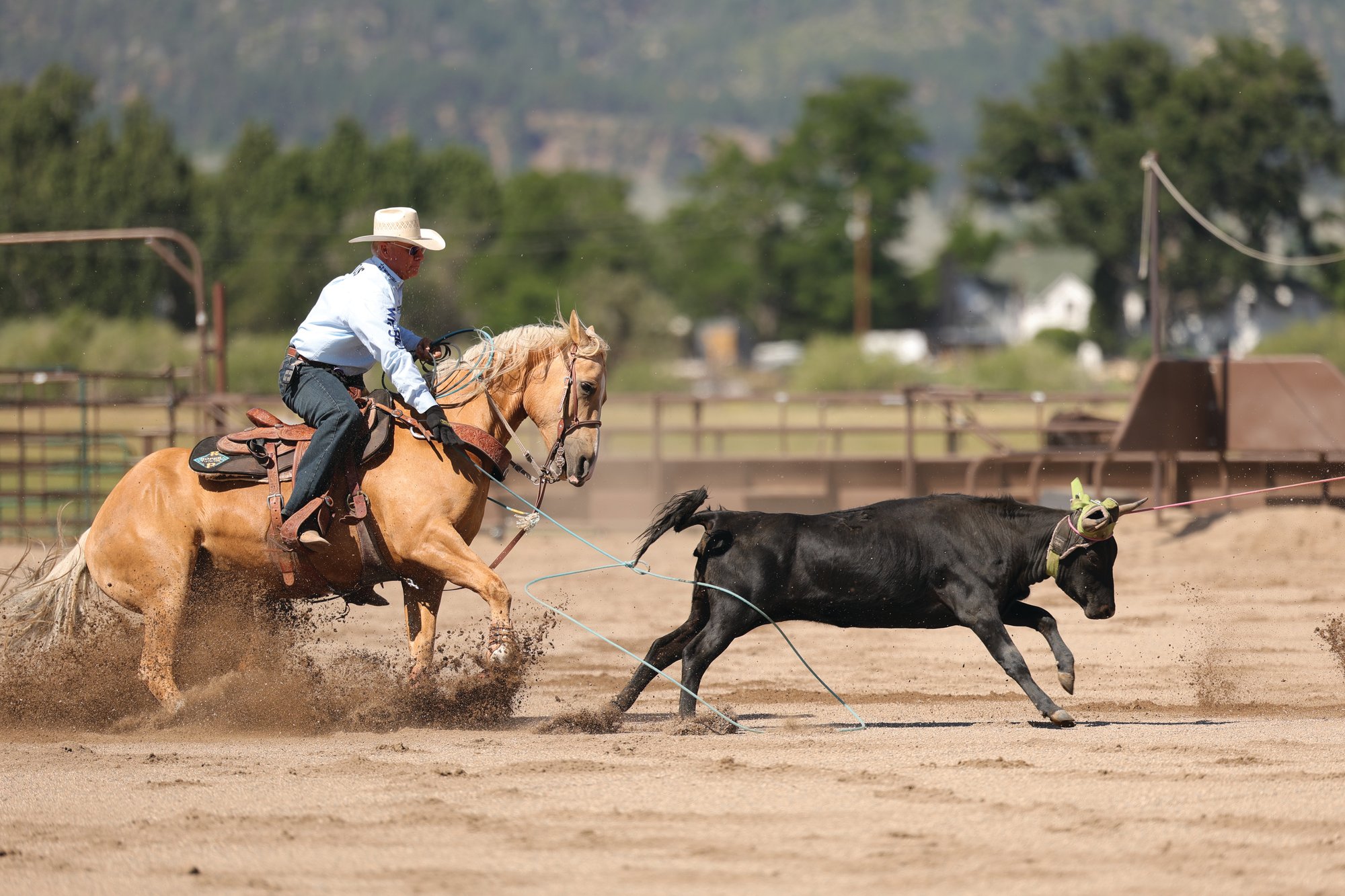
There are so many different levels of ropers in the world, and one thing that’s common at the lower end of the experience spectrum is some simple little things that can become a battle if you don’t get them figured out early on. Bad habits and muscle memory are a bad mix.
Start With How You Hold Your Rope
Something as simple as how you hold your rope matters. There are typically one or two people at every roping school who never learned to properly cross their slack strand to the right of their loop strand and hold that position so that the release of the loop comes out of their hand first.
There’s a telltale sign when I see somebody throw a loop. If the loop tries to jump over the top of the slack strand, it’s an indicator that they’re holding their rope backward in their hand. The loop is trying to go where they’re sending it, but the slack strand is in the way of allowing the loop to do that.
Master the Hook-and-Roll Release
In that same process of elementary procedures early on, learning how to slightly open your hand as you start to deliver, and allowing your thumb to separate your loop and your slack strand as you deliver and release the rope with your fingers—your thumb hooks the slack strand—enables you to roll your hand over your slack and grab it properly with your thumb up and pinky down.
Learning how to do that simple little maneuver in your release also makes the loop turn into position as you’re hooking your slack with your thumb and releasing the loop strand with your fingers. What I would call that is a hook-and-roll release.
You can go on Facebook Reels or Instagram and pull up your favorite heelers of today, and screenshot their release. Almost every single one does a hook-and-roll release every time to deliver their loop, keep the slack connected to their hand and roll over the top to get their slack.
Mind the Slack Between Your Hands
Without learning that, you learn to release and grab your slack incorrectly—usually with your thumb down and in the wrong position to dally. What goes along with that mistake is ropers just starting out with no instruction having too much rope between their hands. That makes it easy to swing, but causes an improper release. It’s another thing you’ll notice if you watch the top ropers: The slack between their hands is virtually the same from roper to roper, anywhere from a foot to a foot and a half at release time.
This all goes back to the elementary process. You have to feed the slack between your hands out and into your loop, so your left hand holding your coils and your right hand holding your loop get to the proper distance for release time.
Keep Your Loop Vertical
Another thing that less experienced ropers don’t realize is that every top roper has a little bit of a different swing and uses different angles, but the thing they have in common is when they start to throw they lock any rotation out of the loop at the start of the delivery. They lock and hold a vertical position of the loop—top and bottom—from the start of the delivery down to the right side of the steer to maintain their top and bottom strands hitting or landing at the correct angle to come across the catch zone.
There’s a purpose for the top strand, which is the hock, and the bottom strand, which is the surface of the ground. That’s why it’s important to lock that vertical position from the start of the delivery to the outside right leg of the steer to maintain that proper angle.
We have so much information at our disposal today, including videos of the top ropers at the big jackpots and rodeos. If you’re studying what they do, it’s helpful to know what to look for, including the distance between their hands, their release and how their thumb hooks the slack. They might not swing their ropes the same or ride the same kind of horses, and some might rope faster than others, but there are several things they do the same.
There’s a reason they do a few things in common. It brings success. It takes a ton of practice to get these key little fundamentals down and drill them into your muscle memory. But when you do, you have them forever.
—TRJ—